
Hello, this is the Macrogic editor. Editor’s Insight is written from the editor’s own point of view; if you are looking for our data-driven, methodical analysis, start with the links below.
1. Which assets fit today’s market → Daily Digest
2. Probabilities for the up, sideways and down scenarios → Weekly Outlook
Next week, most of the market’s attention will go to two places: US consumer prices on Oct 14, and the run of big-tech earnings that begins late this month. The usual assumption is that if the AI bubble bursts, a disappointing earnings report will be what bursts it. I see it a little differently. If that trigger is pulled, I think it is more likely to happen in Europe’s bond market than on an earnings call. The first crack is more likely to show in what AI companies pay to borrow than in what they earn.
The strain started in France. On Oct 1, the French 10-year government bond yield touched 4.96% intraday, its highest level since July 2002. A cleaner gauge is the spread over Germany: how much extra yield France has to offer to borrow for ten years. That spread closed at 146.9bp on Oct 2 (a basis point, or bp, is a hundredth of a percentage point). Its low over the past year was 59bp, so the gap is now about two and a half times as wide.
The fiscal backdrop explains why. France’s public debt stands at 119% of GDP, a postwar high, and this year’s deficit is expected to come in at 5.4% of GDP. The government’s budget for next year includes a €43 billion fiscal package that combines tax increases with spending cuts. The real uncertainty comes before the numbers: whether parliament passes the package, and whether the cabinet holds together long enough to see it through. On top of that, Marine Le Pen leads the polls for next spring’s presidential election.
Still, I would not read this as a rerun of Europe’s 2011 debt crisis. An analysis from EFG International put the two-year French-German spread at about 65bp on Oct 2, less than half the 10-year gap. My read is that markets doubt France’s long-run finances more than its ability to pay its bills in the near term. This is not a crisis. It is the premium attached to the possibility of one, and that premium is growing.
The currency points the same way. On Oct 5, the euro slipped intraday to $1.116 per euro, its weakest in 17 months. What I find telling is that it fell even though the European Central Bank raised rates in June and in September. When a currency weakens while it pays more interest, the rate gap cannot be the whole explanation. Markets are filling in the rest with fiscal worry.
The Middle East, meanwhile, is lifting the floor under yields. Brent crude settled at $104.72 a barrel on Oct 9. Reports counted nine attacks on ships in the Strait of Hormuz in October through Oct 6, and the US blockade of Iranian ports is still in place. President Trump has said he will not strike Iran before the Nov 3 midterm elections, but he made no promise about the period after that. Expensive oil pushes up inflation expectations, and buyers of long-dated government bonds then ask for higher yields.
Britain shows how that works. On Oct 1, the UK 30-year yield went above 6% intraday for the first time since 1998, with both fiscal concerns and energy-driven inflation concerns cited as causes.
Now to AI, which is the part I actually want to talk about.
AI data centers are no longer paid for only out of the cash companies keep on hand. They are being built with borrowed money as well. The large cloud companies known as hyperscalers, such as Alphabet, Amazon, Meta, Microsoft and Oracle, have issued $48 billion of bonds in euros, pounds and Swiss francs this year (as of Sep 25, according to Apollo). That is more than three times the total for all of last year. Meta has also been reported to be preparing its first trip to the European bond market this fall. European investors’ money has become one of the funding lines for American AI spending.
And those investors are already asking a fairly high price.
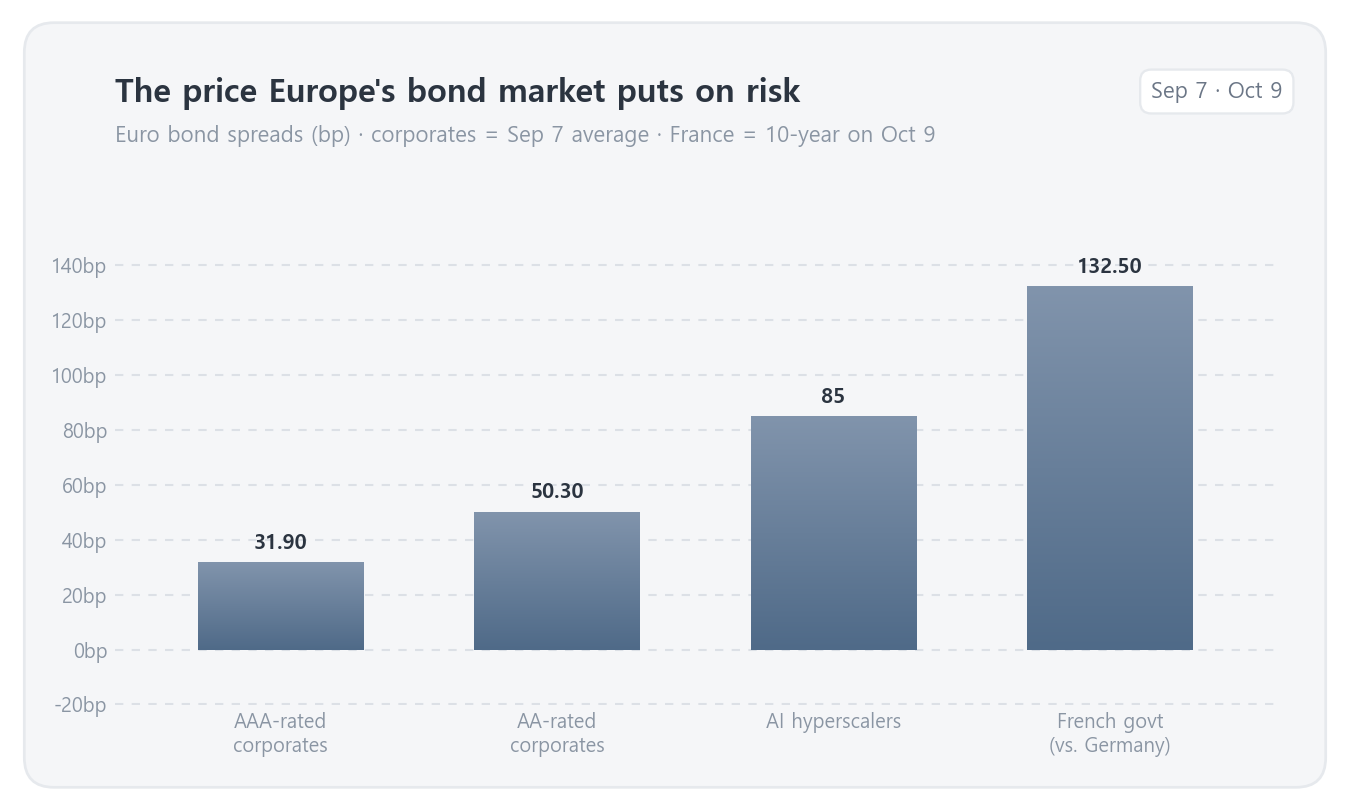
In the euro secondary bond market on Sep 7, AAA-rated corporate bonds traded at an average spread of 31.9bp, the extra yield investors demand for lending to that borrower. AA-rated bonds traded at 50.3bp. Hyperscalers traded at 85bp, even though the group includes companies with near-top credit ratings such as Alphabet (AA+) and Amazon (AA).
In that same market, France was paying 132.5bp more than Germany on Oct 9. A corporate spread and the gap between two government bonds are measured differently and on different dates, so you cannot simply add one to the other. But when the same investors can earn more on government bonds, the yield they ask of AI borrowers is more likely to rise along with it.
Why this matters for stocks: US equities have very little cushion right now. In our Oct 10 report, the S&P 500’s earnings yield (expected earnings as a share of price) was 5.26%, while the US 10-year Treasury yield was 5.24%. Measured on expected earnings, stocks offer only 0.02 percentage points more than bonds. In other words, stocks are not cheap against bonds. In that position, even good earnings may not protect valuations if yields tick up a little further. The semiconductor ETF SOXX already sits 14.7% below its peak.
Put the pieces in order and the chain looks like this. If France’s fiscal strain lifts spreads in Europe, that could spread into what AI companies pay to borrow there. The Middle East holds up long-term US yields through oil, which could wear down that 0.02-point cushion. The two paths meet at one point: the discount rate the market applies to AI.
The evidence against this is not trivial. Apollo found little sign “yet” that hyperscaler issuance is crowding out other companies’ borrowing, and European corporate spreads remain low. The French spread has also eased back from its high, to 132.5bp on Oct 9. So please read this not as a forecast of a collapse, but as a map of the order in which the cracks would appear if they do.
I am watching three things. Whether the French-German 10-year spread closes back above its Oct 2 close of 146.9bp. Whether Brent starts settling above $105. And how many basis points Meta’s first euro bond has to pay when it arrives. I think the last one is the most direct signal: in the very market where French yields are wobbling, it is where the price European investors put on a new AI borrower gets printed as a number.